We take purple for granted.
Today, hues spanning the spectrum of purple and violet can be fabricated by household printers, LED screens, and any toddler with a marker and a dream.
There’s not even a little pulverizing.
Two thousand years ago, the states and people of the Mediterranean had no such luxury. Robbed by time of printer, computer, and toddler marker, they were forced to make due with what was available. And who needs dot-matrix printing when you have snails?
Before the advent of advanced color-mixing technology, things came in one color until someone found something that made a different color, and made it reliably and in such quantities that it could be used to make other things that color.
Early(ish) humans discovered ways to dye materials and fabrics all manner of colors, from “brown” to “different brown”. Occasionally, someone would discover a way to formulate a different color. Some of these methods drew from plants or resources that were abundant in their environments. Others, less so.
For the people of ancient Rome, vibrant colors were hard to come by, but none so hard as purple.
Over time, Rome’s most famous purple would gain its imitators and competitors, but this particular kind of purple built a reputation on both vibrancy and colorfastness, the quality of maintaining color through washes and over time.
To make this dye, a color closely associated with the city of Rome but more accurately attributed to the city of Tyre in modern-day Lebanon and, appropriately, known as “Tyrian Purple”, a dye-maker would have to start with a snail.
To dye anything worth wearing, dye-makers had to crush tens of thousands, or, more likely, hundreds of thousands of these little drippers. It’s worth asking if such a grotesque and time-consuming process has any value at all.
For the average Roman? Absolutely not. But for the extremely ultra wealthy, value is all it has.
Purple reign
Why go through the effort of steamrolling millions of snails for minimal quantities of dye? Because rich folks will pay big money. Why spend huge sums of money on purple clothing when other colors are readily available? Because you can, obviously, and the poor cannot.
This is conspicuous consumption, a term first used by sociologist and Shelleyan antihero Thorstein Veblen to describe the consumption of goods not for their intrinsic value, but rather their extrinsic social value. In other words, you don’t buy a purple toga because you need it, you buy it to show you have enough spare cash to spend on something everyone knows is expensive. You buy expensive things to prove you can buy expensive things.
It’s not hard to find modern parallels. Supercars, precious gemstones, gaudy watches, designer clothing, the I Am Rich app. Insulin.
Initially, in Rome and in other predecessor and contemporary Mediterranean states, that inability for any but the most powerful to spend money on purple goods was ensured by the invisible hand of economics. In time, this distinction would be enforced by law.
If only a society’s elite can afford to be dripped out like Prince, then an abundance of purple becomes a key indicator of an individual’s social standing. In the case of Rome, purple became the purview of the most elite of the elite, first the members of the Republican Senate and then, eventually, the Emperor.
But, as many societies eventually learn, purchasing power doesn’t remain the exclusive domain of government figures when capital is allowed to run amok. Eventually, against all odds, new blooded merchants may be able to shell out untold volumes of cash for mucus-soaked clothing.
Today, that’s the price of doing business. In Rome, that’s a big fucking problem. If the Carthaginian Koch brothers can afford purple JNCOs, it means the Emperor in his purple tracksuit is less special. And the emperor can’t be less special.
So some emperors passed and enforced sumptuary laws, legal restrictions on the enjoyment of certain luxuries, in this case on the wearing of certain articles of clothing by people whose social status made them unfit to enjoy the best of the best or at least to look like the best of the best.
And through most of Roman history, the social crème-de-la-crème was the senate, a body of wealthy patricians (the Roman noble class, opposite the plebeians) that exercised legislative political power during the Republican era and did a very good job of playing pretend during the time of the Roman emperors.
Even at the height of their power, senators were afforded the right to wear white togas that were merely bordered with a single stripe of Tyrian Purple. To use any more, they’d have to be much more important.
The most obvious of the purple-wearers were the emperors, but the right to galavant as the Grimace of antiquity was extended to more than just Rome’s boss of all bosses. Generals returning from successful conquests were allowed, alongside a variety of other benefits, to wear the purple toga picta, as it was called, during the special honorary parade known as a triumph.
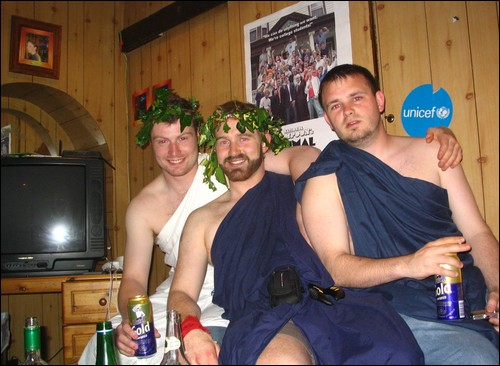
In a world obsessed with status and void of facial recognition software, methods of recognizing social standing at a glance were held as important. Alongside the toga picta, those who sought public office identified themselves by wearing white togas that had been further whitened by rubbing them with chalk. Just as onlookers would be able to identify figures of paramount status at first sight of the purple toga picta, seeing someone in a bright white toga (in Latin, toga candida) was an easy way to identify a candidate.
A complete list of forbidden finger paints
Laws and norms limiting the wearing of certain colors weren’t limited to ancient Rome. Entering the medieval period after the fall of the Roman Empire, purple retained its luster, especially in the Byzantine Empire, Rome’s Eastern spinoff. With time, though, Western European monarchs would turn their eyes to crimson, a vibrant shade of red produced, not unlike Tyrian purple, by crushing millions of small animals. No snails were harmed in the manufacture of crimson, however.
Instead, the production of crimson dye claimed the lives of untold millions of tiny insects, first the kermes scale insects, who live around the Mediterranean and whose name shares a root with the word “crimson”, and eventually cochineal, tiny beetles that live and die on cacti in Central and South America.
Further afield, Chinese emperors claimed yellow as their exclusive outfit color, and their neighbors in Japan cultivated a longer list of specific hues forbidden to commoners.
Often, these legal restrictions read as attempts to reinforce previously-standing economic truths. If Tyrian purple is hard to make, then to have it is a luxury, perhaps one only the Emperor can afford. But as history marches on and enterprising businessmen find themselves better situated to farm beetles than the agents of the crown, a monarchical government preoccupied with the optics of limiting luxury may step in and write into law what was previously understood to be a fact of nature: that royalty trumps the forces of supply and demand.
It was rarity that made Tyrian purple and kermes crimson so valuable. It was for that same reason that painters long valued ultramarine, a pigment made from lapis lazuli, a rare semi-precious stone imported at one time almost entirely from Afghanistan. So associated was this stone with blue in art and culture that it’s from the name lapis lazuli that several languages of Iberian origin, like Spanish and Portuguese, take their words for blue. “Azul” (and the English “azure”) is named after the rock, not the other way around.
One way to ensure the rarity of a pigment is to closely guard the secret of its production. This was done in the case of Tyrian purple just as it was done a world away (or, at least, one Persia away) in South Asia where dye-makers hid their technique for the production of Indian yellow.
Long unknown to the west, the apparent secret of Indian yellow’s creation was revealed in nineteenth century correspondence from curator of the Indian Museum Troilokyanath Mukhopadhyay, who reported that the manufacture process involved feeding cattle a nutrient-sparse diet of 100% mango leaves, collecting their pungent urine, and drying it, resulting in bright orange-yellow rocks that provided the basis for the pigment.
This is the first time we’re talking about urine, but its fumes have never been far away. Roman launderers and dyers interested in setting and maintaining the colors of fabrics used human urine as their setting agent, collecting it from public urinals like the Nathan Fielder-coded freaks they were. If the textile industry wasn’t in need of bottled pee on any given day, urine traders weren’t entirely out of luck: Romans also used it as mouthwash.
In later centuries, humans would, of course, move on from cleaning each other with urine and onto killing each other with it by way of gunpowder , which was produced in small part by (god, bear with me) mixing piss and shit to create potassium nitrate, a core ingredient.
Turning as fast as we can back to pigment, a not entirely dissimilar technique was used in the creation of lead white, long the premier white in a painter’s arsenal. Lead shavings were immersed in vinegar in pots that were themselves then buried in manure. Today, lead white is largely a relic of the past thanks to its toxicity. That’s the metal that’s toxic, not the presence of spiritual poop particles.
Lead, though, like human waste, is relatively common, and thus cheap. It’s this inexpensiveness that made lead paint an attractive option for both industrial and consumer applications, being found in more than 80% of American homes built before 1978. “Cheap and useful” could have been lead’s lasting identity had it not developed a better reputation for making those exposed to it shorter, dumber, and violent as hell.
But, of course, none of that matters to the discerning artist focused on collecting only the rarest and raddest colors. Ultramarine was coveted for its rarity, as were cochineal, kermes, and Tyrian purple.
Artists able to access these rare pigments would be able to create art that other, maybe lesser, artists could not. Sure, there were other ways to make purple or blue, but not this purple, and not this blue. And it’s not only vibrant colors that artists and their suppliers determined worthy of special effort. Even the dullest of earth tones can benefit from a little splurge every once in a while. For maximum prestige, just as in the cases of ultramarine and kermes before them, these creators would need something rare.
And what’s rarer than three-thousand-year-old dead people?
Enter the Mummy
Religious ancient Egyptians believed that the only way to ensure the reunification of body and soul in the afterlife was through preservation of one’s corpse after death. Over the course of several weeks, ritual embalmers removed, treated, and stored a body’s internal organs (except the heart, which itself would be important in the afterlife) before sewing up, dehydrating, and wrapping the body to prevent natural decomposition. The result is a mummy, a human corpse preserved enough to survive the transition to the afterlife and, in many cases, to persist through millennia in our world as well.
The mummies we’re most familiar with are those of the pharaohs, the kings and queens of ancient Egypt who ruled so long ago that the period of Egyptian history starting more than three thousand years ago around 1550 BCE is known as the “New Kingdom”. The earliest of these leaders, Narmer (whose name means something like “stinging catfish”) reigned more than 1500 years before that, around 3100 BCE. Over time, the ritualistic embalming and mummification of the pharaohs became more and more complex, with Narmer’s post-life dwelling constituting a couple of subterranean rooms and his distant successor, Khufu’s tomb being, at the time of its construction, the largest building in the world.
New York’s Empire State Building was the tallest manmade structure in the world for 43 years. The Great Pyramid held that honor for nearly four thousand.
Wealth, prominence, prestige, and hiding their bodies in the largest piles of rock imaginable to the ancient human mind all contribute to our familiarity with the mummies of pharaohs, but the process of mummification was itself open to anyone who could afford it. As a result, the Egypt of the early modern period was a veritable treasure trove of thousand-year-old dead folks.
At least until Europeans got there.
We don’t know when Europeans started grinding up mummified corpses they’d nabbed on holiday from the souvenir tomb nearest their hotels, but we do know that it took a while for them to try to turn the ground-up mummies into paint.
Because they were busy eating them.
More like “curse of the yummy”
Europeans’ first interest in pharaoh-based flour was medicinal. Enterprising European medicine traders began acquiring and grinding up mummies with the understanding that their bodies were prepared with bitumen (or asphalt), which they valued for its medicinal properties.
Since then, we’ve learned two things: bitumen does not have any medicinal properties and the vast majority of mummies were not prepared with bitumen at all.
So, with a newfound surplus of long-dead kings and kin stinking¹ up their warehouses, importers had to pivot. Much like today’s AI models, there was simply no room in the market to not find an industrial use for three thousand year old corpses.
The oldest documented use for mummy brown pigment comes from the studio of Juan Pantoja de la Cruz, court painter for King Philip III of Spain.
Napoleon’s voyages to and conquests in Egypt led to a renewed wave of European interest in one of the world’s oldest civilizations and Europe’s supply of trans-Mediterranean mummies skyrocketed. Tourists visiting Egypt couldn’t content themselves with today’s model pyramids or anatopistic snow globes. There’s no better way to bring home a piece of Egypt than by shipping over a dead Egyptian.
Europeans used mummies as souvenirs and decor, but these victims of post-human trafficking also acted as centerpieces for what Victorian Britons called “mummy unwrapping parties”. Collectors of Pokémon Cards or Labubu can only imagine the rush that comes with unwrapping first edition holographic Nefertiti.
Demand grew so high for body paint (evil version) that manufacturers may have begun forging it from the recently-deceased. In other words, unwary artists may have been painting with dead people rather than very dead people.
In the case where corpses, ancient or not, were totally unavailable, paint makers were able to make “imitation mummy” (fine on canvas, bad in rangoons) by mixing calcium oxide (lime) with that coveted bitumen.
Ultimately, unlike the pigments made of stone and snails, the brown tones attributable to ground-up human were neither expensive nor particularly coveted; according to Harvard Art, “critics condemned its use because of its instability”.
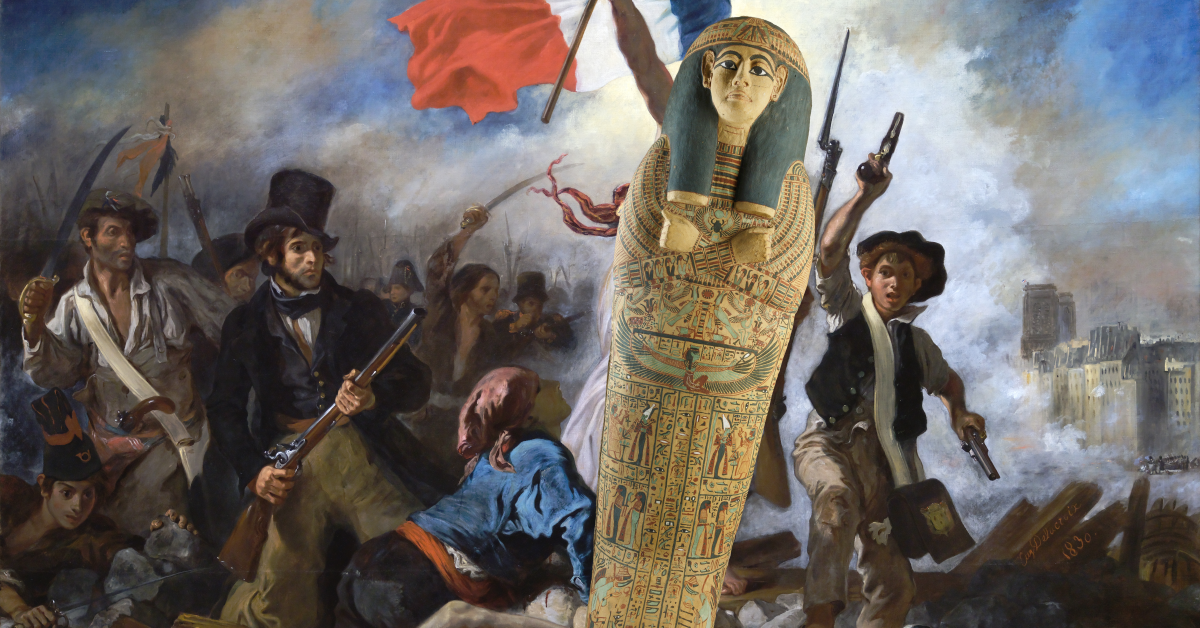
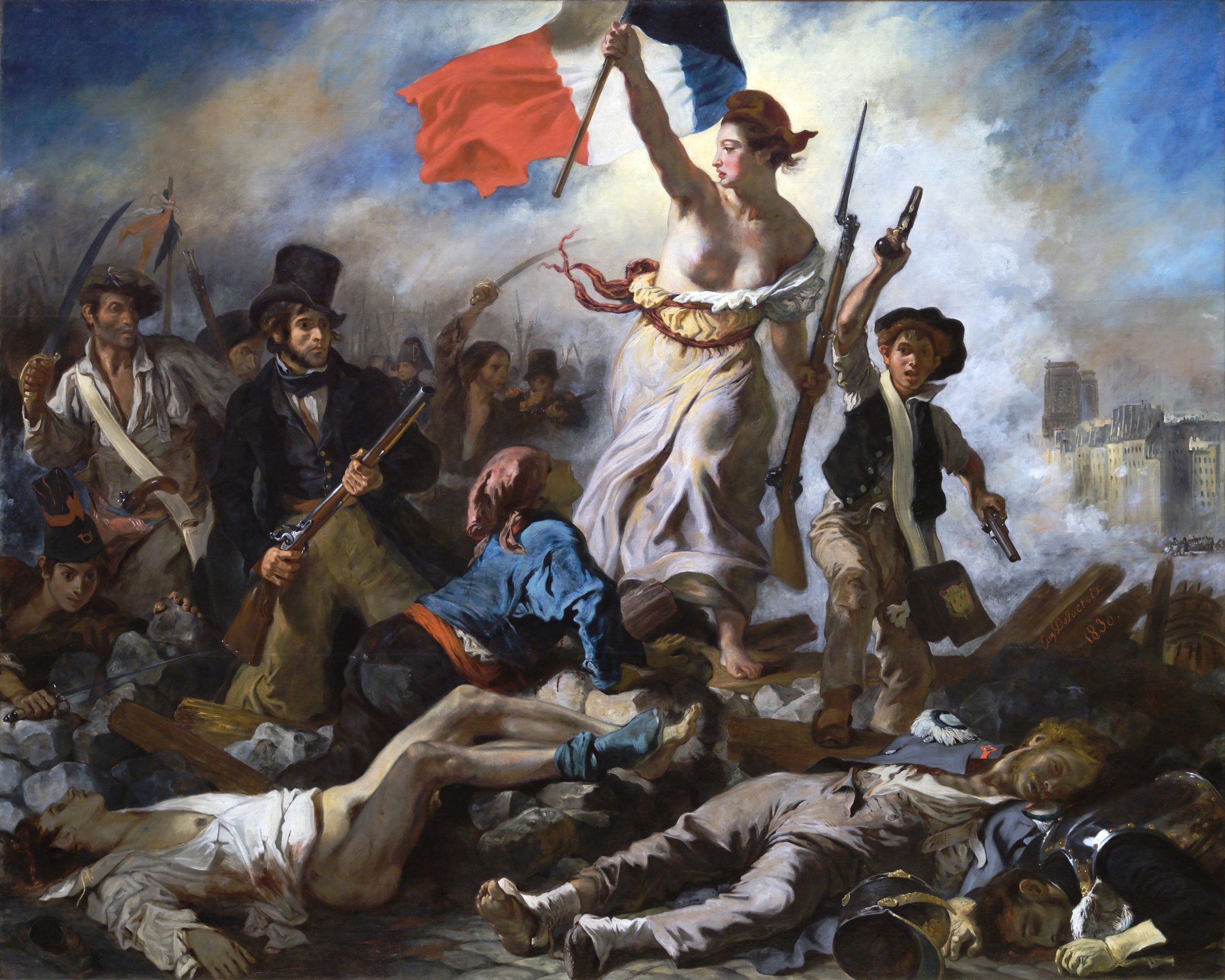
Hard evidence for the use of mummy brown in any particular painting is difficult to come by, as there’s no scientific test that can verify whether or not a given painting’s earth tones came from the children of sun god-blessed ancient incest. But the paint was present in the studios of artists like the aforementioned de la Cruz and his francophone surname-twin Eugène Delacroix, who may have used it in his famed Liberty Leading the People, a painting depicting the violent lengths the French citizens of the 1830s were willing to go to see a boob.
One painter known to have used the pigment was Edward Burne-Jones, uncle-in-law of Rudyard Kipling of Jungle Book fame. The story goes that Burne-Jones had assumed “mummy brown” was just a quirky name and not a literal description of the contents of a tube of paint. (You’d be forgiven for assuming that baby blue is not made out of babies. It is, but you’d be pardoned for your ignorance.)
On learning that he’d been using corpse paint long before any metalhead had the inkling, Burne-Jones apparently insisted on providing a proper backyard garden burial for his portion of stolen mummy.
As the world advanced into the 20th century, the Harvard Art Museums’ Sally Woodcock writes “mummified bodies of ancient Egyptian people were no longer seen as an appropriate raw material for paint”, which is by far my favorite quote in this article. She adds that “demand for mummy, which had never been strong, disappeared.”
Some art suppliers were still openly advertising tubes of mummy brown as late as the eve of the Second World War in 1939, and manufacturer C. Robinson only discontinued production of its line of mummy brown decades later in 1964, citing the critical issue of having run out of mummies to pulverize.
In decades since, the repurposed relics have become relics themselves, relegated to the shelves of art museums and the occasional unexplored corner of a paint shop office drawer. Maybe tubes of authentic mummy-based paint can still be found in some back-alley brown market, but if there’s someone out there still turning long-dead Egyptians into pigment, they’re keeping it under wraps.
¹ Mummies probably weren’t stinky. More recent reports indicate that their bouquets are most often sweet, spicy, and woody.
Images
- Toga party.jpg by Wikipedia user Lithiumoxide
- Licensed under the GNU Free Documentation License
- I don’t legally have to credit the artists behind the oil painting or the Sarcophagus, but I do have to acknowledge these guys.

Read/Watch More
- From Gunpowder to Teeth Whitener: The Science Behind Historic Uses of Urine by Mohi Kumar for Smithsonian magazine
- The gory history of Europeans eating mummies for health by Erin Blakemore for National Geographic
- Grave Mistakes: Art, Exploitation, and the Legacy of Mummy Brown by Adam Budziszewski for Archeowiesci from the Faculty of Archaeology at the University of Warsaw
- Mummy Brown: A Modern Pigment’s Problematic Past by Sally Woodcock for Harvard Art Museums
- Renaissance Dress in Italy: 1400-1500 by Jacqueline Herald
- The library of rare colors by Tom Scott
- The Secret Lives of Color by Kassia St. Clair
- Tutankhamun’s Tomb: The Thrill of Discovery by Susan Allen
- Tyrian purple: the first four thousand years by Chris Cooksey for Science Progress
- Tyrian purple: The lost ancient pigment that was more valuable than gold by Zaria Gorvett for the BBC
- Was This Masterpiece Painted With Ground Mummy? by Kristin Romey for National Geographic